Receiving hole
Define molded or machined hole geometry and its tolerance, not just a nominal diameter.
THREADED INSERTS
Explore mechanically installed inserts when your assembly calls for a controlled pressing or expansion process.
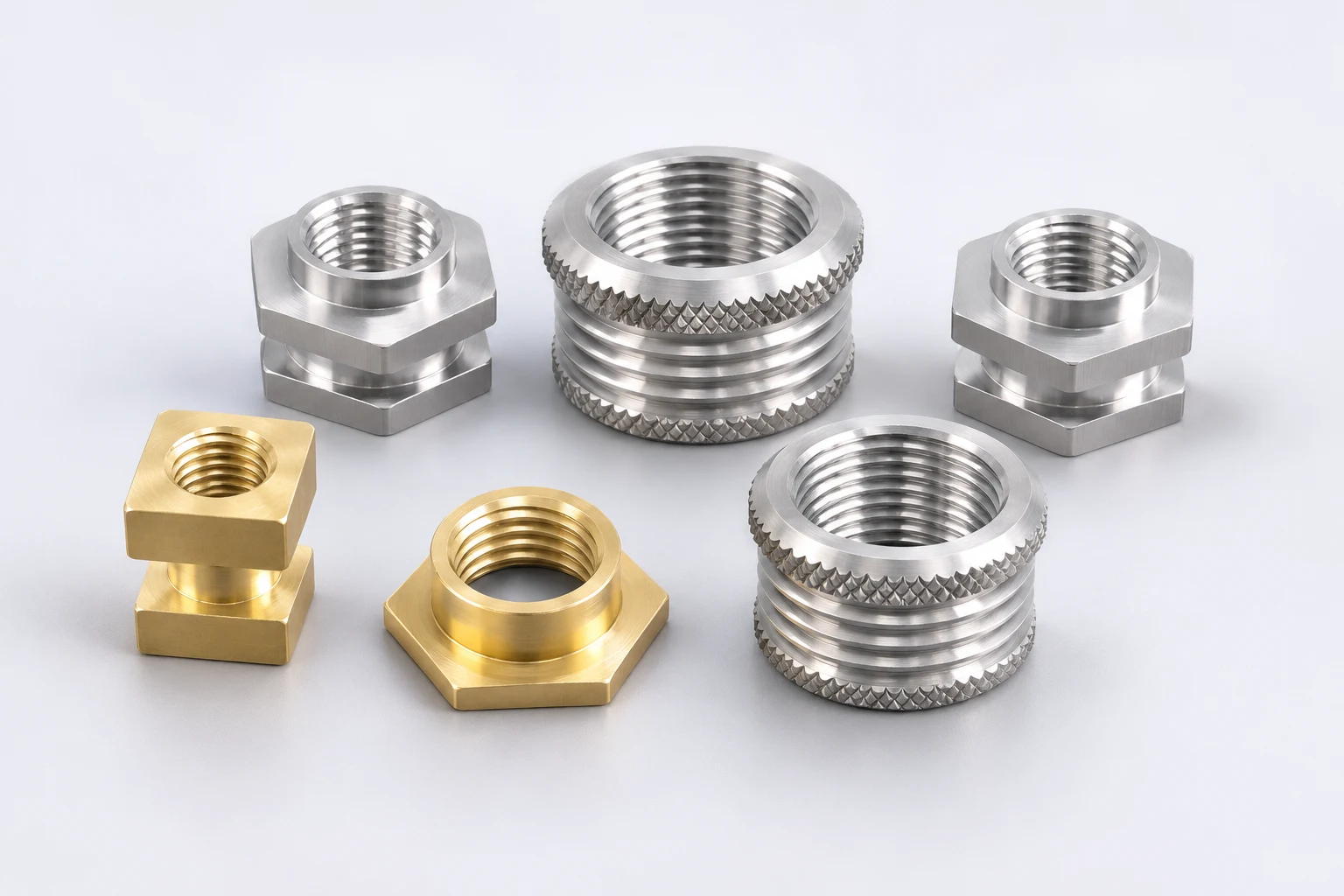
HOW IT WORKS
Press-in families use their external geometry and the receiving hole to retain the insert. Expansion designs have a separate expansion mechanism. These are distinct families and should be selected for the required joint and assembly sequence.
Components where the plastic, wall thickness, access and load requirements support a mechanical installation route. The proposed style must be reviewed for the particular host material.
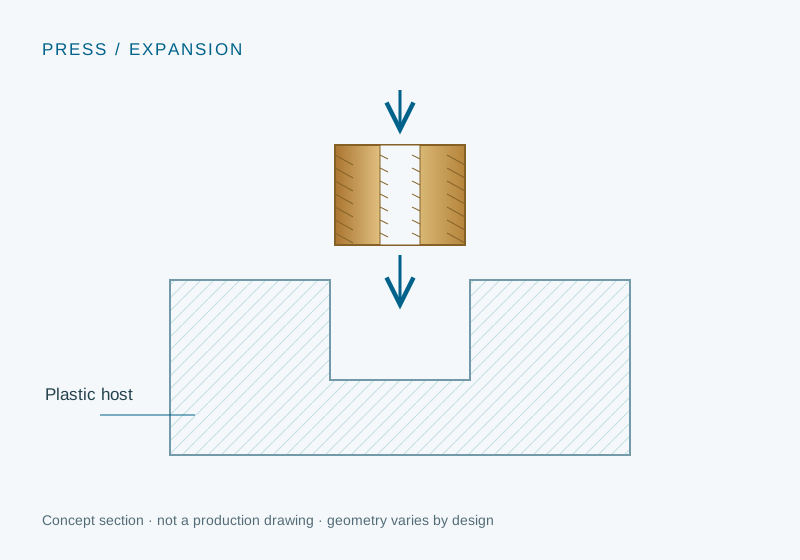
APPLICATION REVIEW
Define molded or machined hole geometry and its tolerance, not just a nominal diameter.
Review the plastic grade, surrounding wall, edge distance and risk of local cracking during installation.
Confirm the installation direction, tool clearance, support under the part and seating position.
For expansion styles, identify what causes expansion and how subsequent screw installation or removal affects retention.
CUSTOM OPTIONS
Body profile, lead-in, flange, length, retention features and thread details can be reviewed. The installation method is selected before finalizing the external geometry.
| Requirement | Useful RFQ information |
|---|---|
| Thread / bore | Standard, pitch or bore fit; usable engagement and mating hardware |
| Envelope | Body dimensions, shoulder, flange, location and surrounding clearance |
| Material / finish | Specified grade, surface treatment and service environment |
| Volume / timing | Sample quantity, order quantity, repeat demand and required delivery |
| Acceptance | Drawing revision, critical dimensions, sample checks and documents |
COMMON QUESTIONS
Do not assume this is an equivalent installation. Use a style intended and validated for the proposed process.
No. The retention mechanism and assembly sequence can differ. Send the intended screw and installation details so the correct family can be reviewed.
YOUR NEXT STEP
A drawing, a sample photo or a clear description is a good place to start.