Exposed thread
Define thread standard, pitch, usable thread length and any thread protection needed during manufacturing.
EXTERNAL THREADS
Bring an external metal thread into a plastic component when the assembly requires a nut, bracket or mating attachment on a stud.
HOW IT WORKS
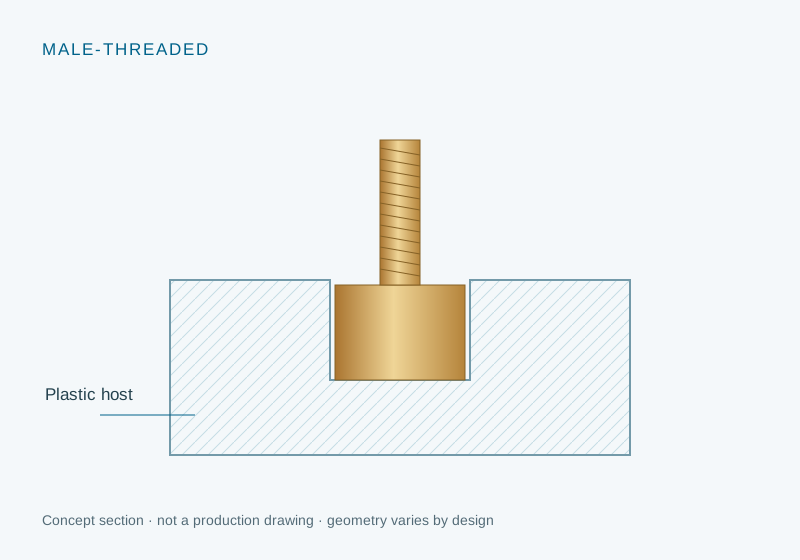
A retained insert body anchors an externally threaded feature in the host. The exposed thread and embedded portion need to be specified separately.
Molded housings, mounting interfaces and custom assemblies with an external threaded connection. The appropriate molded-in or post-mold route depends on the actual body and host design.
APPLICATION REVIEW
Define thread standard, pitch, usable thread length and any thread protection needed during manufacturing.
Specify retention geometry, embedded length, orientation and the surrounding plastic envelope.
Include axial load, bending, tightening torque and repeated assembly requirements.
Review the installation route, datum scheme, protrusion tolerance and whether rotational orientation matters.
CUSTOM OPTIONS
Stud length, shoulders, stops, dual-diameter features, thread ends and custom anchor bodies can be reviewed from drawings or samples.
| Requirement | Useful RFQ information |
|---|---|
| Thread / bore | Standard, pitch or bore fit; usable engagement and mating hardware |
| Envelope | Body dimensions, shoulder, flange, location and surrounding clearance |
| Material / finish | Specified grade, surface treatment and service environment |
| Volume / timing | Sample quantity, order quantity, repeat demand and required delivery |
| Acceptance | Drawing revision, critical dimensions, sample checks and documents |
COMMON QUESTIONS
Yes, a stepped configuration can be reviewed as a custom design. The dimensions and loading still need to be established.
It is useful when fit, bending, thread engagement or tightening access affects the design.
YOUR NEXT STEP
A drawing, a sample photo or a clear description is a good place to start.